FX clarity, governance, and education — without conflicts.
Independent corporate FX advisory built for middle-market companies.
No trade execution. No bank conflicts. Just expertise aligned
entirely to your business.
CFX Group provides independent advisory services, practical policy
development, and experience-based education that help organizations
strengthen their approach to foreign exchange risk management. Our
objective is to support informed decision-making through practical
guidance and nearly four decades of experience.
38+
Nearly four decades of experience advising organizations on
foreign exchange risk management, treasury practices, policy
development, and governance.
CFX Group brings together advisory services, policy development, and
education to help organizations manage foreign exchange risk through
practical guidance and informed decision-making.
PILLAR 01
Advisory
Independent guidance on currency exposures, hedging strategies,
treasury practices, and foreign exchange decision-making.
Learn More →
PILLAR 02
Policy & Governance
Practical policy and governance frameworks that support
consistent decision-making across finance and treasury.
Learn More →
PILLAR 03
Education
Practical education that helps finance and treasury
professionals build knowledge and confidence in managing foreign
exchange risk.
Learn More →
Who we serve
Built for middle-market companies with international activity.
CFX Group works with organizations that have international
activities or foreign exchange exposures and are looking to
strengthen their approach to FX risk management.
Middle-Market Companies
Startups & Growth Companies
Portfolio Companies
Not-for-Profit Organizations
University Incubators
"Effective foreign exchange risk management begins with asking
the right questions."
— CFX Group
A Practical Starting Point
FX Program Review
A focused, independent assessment of how your company identifies,
evaluates, and manages foreign exchange risk. Designed primarily
for middle-market companies with international activity.
Ready to take control of your FX program?
Schedule a 30-minute consultation to discuss your current FX program,
priorities, and opportunities for improvement.
An independent perspective on foreign exchange risk management.
CFX Group provides independent foreign exchange advisory services.
Because we do not execute trades or provide banking services, our
focus remains on helping clients evaluate alternatives, strengthen
governance, and make informed decisions that support their business
objectives.
Independent by Design
Independent Advice
CFX Group is an advisory firm. We do not execute trades or provide
banking services. Our role is to offer an independent perspective
that complements the relationships our clients already have with
their banking partners.
Deep Corporate FX Experience
Nearly four decades of corporate FX and treasury advisory
experience.
Our experience spans global banking, treasury advisory, and
corporate foreign exchange. That perspective helps us bring
practical insights to organizations managing international
business.
Practical Frameworks
Focus on policy, governance, and process — not products or
short-term views.
Our work emphasizes policy, governance, and practical processes
that support consistent decision-making. Every engagement is
designed around the organization's objectives, operating
environment, and available resources.
Built for Corporate Finance
Designed for Treasury, Finance & Accounting Teams
We work with organizations at different stages of their foreign
exchange journey — from companies establishing their first formal
FX framework to those looking for an independent review of
existing practices.
How we work
What changes when you engage CFX Group
1
Understand
We begin by learning about your business, your international
activities, and your approach to managing foreign exchange
risk.
2
Assess
Together we review current practices, identify opportunities
for improvement, and discuss alternatives appropriate for your
organization.
3
Develop
Where appropriate, we help establish practical policies,
governance frameworks, and processes that support consistent
decision-making.
4
Support
Whether through advisory services, policy development, or
education, our objective is to provide practical guidance that
strengthens your organization's internal capabilities.
See what's possible for your FX program.
A 30-minute conversation can help identify practical next steps for
your FX program.
Three pillars. One practical approach to managing foreign exchange
risk.
Every organization has different objectives, resources, and levels
of international activity. CFX Group provides advisory, policy, and
education services that can be engaged independently or together,
depending on your needs.
FX Program Review
A focused, independent review of how your company identifies,
evaluates, and manages foreign exchange risk.
Pillar 01
Advisory
Independent guidance to support informed foreign exchange
decisions.
Foreign exchange decisions affect cash flow, earnings, and
risk management across an organization. Our advisory services
help companies understand their exposures, evaluate available
alternatives, and develop an approach that aligns with their
business objectives.
Engagements may include reviewing currency exposures,
discussing hedging strategies, evaluating banking
relationships, or providing an independent perspective on
specific transactions or projects.
Services are available on a project basis, through ongoing
advisory relationships, or for specific assignments as needed.
Pillar 02
Policy & Governance
Practical governance frameworks that support consistent
decision-making.
FX policy developmentRisk management frameworksGovernance reportingAudit readinessProcess design
A well-designed FX policy provides a framework for consistent
decision-making. It defines responsibilities, establishes
guidelines, documents governance, and supports communication
across finance, treasury, management, and external
stakeholders.
CFX Group works with organizations to develop policies and
governance frameworks that reflect their business, operating
environment, and risk management objectives.
The goal is a policy that is practical, understandable, and
capable of evolving as the organization grows.
Pillar 03
Education
Building knowledge and confidence across your organization.
FX workshopsExecutive briefingsCustom programsOngoing education
Foreign exchange is a specialized area of finance, yet many
professionals have limited opportunities for formal training.
Our education programs are designed to provide practical
knowledge that participants can apply in their day-to-day
responsibilities.
Sessions are tailored to the audience — from finance teams and
treasury professionals to executive leadership and boards —
and can be delivered as individual workshops or as part of a
broader development program.
Our objective is to help organizations build lasting internal
capability through practical, experience-based education.
Not sure where to start?
A 30-minute consultation helps us understand your situation and
identify a practical starting point.
Built on decades of experience in corporate foreign exchange and
treasury management.
Large corporations have dedicated treasury teams and preferred bank
coverage. Many middle-market companies have meaningful international
exposures without comparable in-house FX resources. CFX Group
brings nearly four decades of corporate FX advisory experience
directly to those companies.
Our Mission
Helping organizations strengthen their approach to foreign
exchange risk.
We do that through independent advisory, practical policy
frameworks, and targeted education — informed by more than 38 years
of experience advising corporate clients within global
financial institutions.
CFX Group operates with a single guiding principle: advice
aligned solely to your business.
Our Approach
Independent Advice
CFX Group provides advisory services only. We do not execute
trades or provide banking services, allowing our advice to
remain focused on your objectives.
Internal Capability
We believe organizations make better decisions when they
understand the risks they manage. Our role is to share
experience, provide practical guidance, and help build
lasting internal capability.
Practical Solutions
Every recommendation should be practical, sustainable, and
appropriate for your organization's people, processes, and
banking relationships.
Who we serve
Built primarily for middle-market companies.
CFX Group focuses on middle-market companies with international
activities. We also support growth companies, portfolio companies,
not-for-profit organizations, and other organizations that value independent advice
and a practical approach to managing foreign exchange risk.
Middle-Market Companies
Companies with international activity that may not have dedicated FX resources.
Startups & Growth Companies
Building FX discipline early — before costly habits form.
Private Companies
Owner-managed or professionally run businesses with cross-border
operations.
Portfolio Companies
PE-backed firms where FX efficiency directly impacts returns.
Not-for-Profit Organizations
Organizations with international programs that need disciplined
FX management.
University Incubators
Early-stage ventures entering international markets for the
first time.
Let's talk about what we can build together.
A short conversation is the fastest way to see if CFX Group is the
right fit for your organization.
Practical perspectives on foreign exchange governance, policy
development, treasury operations, accounting, executive education,
and historical developments in the foreign exchange markets.
The CFX Insight Library is designed for treasury professionals,
finance leaders, executive management, and others responsible for
understanding and managing foreign exchange risk. Each Insight is
intended to be concise, practical, and grounded in real-world
experience.
The CFX Insight Library will be updated periodically as new
perspectives, methodologies, historical observations, and industry
best practices are developed.
Notify Me of New CFX Insights
Receive an email whenever a new CFX Insight is published.
Your email will only be used to notify you when new CFX Insights
are published.
Looking for a practical perspective on your FX program?
Schedule a 30-minute consultation to discuss your current approach,
priorities, and opportunities for improvement.
One of the most common misconceptions in corporate foreign
exchange is that foreign exchange exposure and foreign exchange
risk are the same thing. While the two are closely related, they
are not interchangeable.
Foreign exchange exposure exists whenever a
business decision creates a financial position or anticipated
transaction denominated in a currency other than the company's
functional currency. Examples include selling products in euros,
purchasing inventory in Japanese yen, funding a foreign
subsidiary, borrowing in a foreign currency, or acquiring an
overseas business. In each case, the business decision creates
exposure.
Foreign exchange risk, on the other hand, is the
potential for changes in exchange rates to affect the functional
currency value or financial outcome of that exposure.
This distinction is important. Exposure is a fact; it exists
because of a business decision. Risk is the uncertainty created by
future movements in exchange rates.
Understanding this relationship changes the way organizations
should think about managing foreign exchange. Treasury does not
create foreign exchange exposure. Rather, Treasury's role is to
identify, measure, and manage the financial consequences of
business decisions made throughout the organization. However,
doing so effectively requires more than technical expertise. It
requires an organization to provide Treasury with the appropriate
governance, policies, processes, systems, and authority to manage
those exposures consistently and effectively.
Before discussing forwards, options, hedge accounting, or other
risk management techniques, organizations should first understand
how and where foreign exchange exposures are created. Only then
can they develop an effective strategy to manage the risks
associated with those exposures.
CFX Insight 002
How FX Risk Moves Up the Supply Chain
CFX GroupAugust 20263-minute read
Many U.S. companies believe they have little or no foreign
exchange risk because their overseas suppliers invoice them in
U.S. dollars. From an accounting perspective, that may appear to
be true. Economically, however, the picture is often quite
different.
When an overseas supplier agrees to invoice in U.S. dollars, it is
often assuming the foreign exchange risk on behalf of its
customer. As long as exchange rates remain relatively stable, this
arrangement works well for both parties. However, when exchange
rates move significantly, that risk doesn't disappear; it simply
changes owners.
Figure 1 — Migration of FX Risk Through the Supply Chain
U.S. Buyer Purchases in USD
→
Overseas Supplier Bears FX exposure
→
Local Currency Strengthens Margins compress
→
Supplier Response Absorb · Hedge · Reprice
→
U.S. Buyer Higher procurement costs
Figure 1. Exchange-rate movements can migrate
through commercial relationships rather than appearing directly
as foreign-currency transactions.
Consider a supplier in China that manufactures products locally
but invoices its U.S. customers in dollars. Most of its operating
costs—including labor, rent, utilities, and local taxes—are
incurred in Chinese yuan (CNY). If the Chinese yuan strengthens
against the U.S. dollar, each dollar received converts into fewer
yuan, reducing the supplier's local-currency revenue and
compressing profit margins.
Faced with declining margins, suppliers typically have several
options. They may absorb the loss for a period of time, hedge
their foreign exchange exposure, improve operational efficiencies,
or eventually increase their U.S. dollar selling prices. In many
cases, the result is higher procurement costs for the U.S.
customer.
From the buyer's perspective, there may never have been a foreign
currency payable on the balance sheet. Treasury may see no
transaction to hedge because every invoice arrives in U.S.
dollars. Yet the economic effects of exchange rate movements are
still present—they simply arrive through higher prices rather than
through a foreign exchange gain or loss.
This distinction is important because it highlights the difference
between financial exposure and economic exposure. While Treasury
may not be managing a direct foreign currency transaction, the
business is still affected by changes in exchange rates through
its supply chain.
The same principle extends beyond China. Whether sourcing
materials from Europe, Mexico, Japan, or other international
markets, exchange rate movements influence supplier profitability,
pricing decisions, and ultimately the cost structure of their
customers. Foreign exchange risk rarely disappears; it usually
migrates to the party least able—or least willing—to absorb it.
Understanding where foreign exchange risk resides is an important
part of developing an effective risk management strategy.
Sometimes the greatest foreign exchange risk is not the
transaction Treasury can see, but the one embedded within the
commercial relationships that support the business.
CFX Insight 003
Intercompany Netting in 5 Minutes
CFX GroupAugust 20265-minute read
As multinational organizations grow, so does the volume of
transactions between their legal entities. Subsidiaries may buy
from one another, provide services, share expenses, lend funds, or
settle balances in multiple currencies. Over time, what begins as
a manageable process can become operationally complex and create a
large number of intercompany payments and foreign exchange
transactions.
Intercompany netting is one way organizations can simplify that
activity. It is not appropriate for every company, but where
transaction volumes are meaningful, it can reduce payment
activity, improve visibility, and make the foreign exchange
process more efficient.
1. What is Intercompany Netting?
Intercompany netting is the process of offsetting payables and
receivables between affiliated companies so that each participant
settles only its net position rather than every individual
invoice.
For example, if a U.S. parent owes a European subsidiary $1
million and that subsidiary owes the U.S. parent $800,000, the two
entities could settle only the $200,000 difference rather than
making two separate payments. In larger organizations, the same
concept can be applied across multiple entities and currencies
through a centralized multilateral netting process.
The objective is simple: reduce the number of individual
settlements without changing the underlying economics of the
intercompany activity.
2. Why and when would a company use it?
Netting tends to become more valuable as the number of legal
entities, currencies, and intercompany transactions increases. A
company with only one foreign subsidiary and a handful of
intercompany payments may have little reason to establish a formal
netting program. A multinational with dozens of entities
exchanging hundreds of invoices each month has a very different
problem.
Organizations typically begin exploring intercompany netting when
payment volumes become difficult to administer, foreign exchange
transaction counts rise, banking fees increase, or Treasury wants
better visibility into global intercompany cash flows.
Growth through acquisition can also be a trigger. Newly acquired
businesses often bring their own banking relationships, settlement
practices, and accounting processes. Netting can provide a
framework for standardizing those activities over time.
3. What are the benefits?
The most obvious benefit is fewer payments, but the potential
value extends beyond payment reduction. A well-run program may
lower banking and settlement costs, reduce the number of FX
trades, simplify reconciliations, improve cash-flow visibility,
and create a more standardized operating process.
From an FX perspective, Treasury can often manage a smaller net
currency position instead of executing numerous individual foreign
exchange transactions. That can reduce operational workload and
make execution more efficient.
Netting does not eliminate the underlying intercompany activity.
It simplifies how that activity is settled and how the resulting
foreign exchange is managed.
4. How difficult is it to implement?
The answer depends largely on organizational complexity.
Technology can automate the calculations and settlement process,
but technology alone does not create a successful netting program.
Organizations need accurate intercompany balances, reliable ERP
data, standardized settlement calendars, clearly defined
responsibilities, and agreement among participating entities on
how exceptions will be handled. Treasury, Accounting, Tax,
Information Technology, and local finance teams may all have a
role.
Legal, regulatory, tax, and accounting considerations can also
differ by country, which means a global program may need to
accommodate local restrictions rather than assume every entity can
participate in exactly the same way.
5. What internal resources are required?
Intercompany netting is not entirely “set it and forget it.” Each
settlement cycle requires some combination of balance collection,
validation, discrepancy resolution, settlement instruction, FX
execution, reporting, and exception management.
The internal burden depends on the number of participating
entities and the degree of automation. Some organizations can
manage a modest program with existing Treasury and Accounting
resources. Others may need specialized technology, shared-service
support, or an external provider to keep the process efficient.
This is why the business case should consider more than
transaction-cost savings. A program that reduces 200 payments but
requires significant manual effort to administer may not deliver
the expected benefit.
6. What are the alternatives?
Formal multilateral netting is only one approach. Smaller
organizations may use bilateral netting, where
two entities offset balances directly with one another. Larger
organizations may centralize execution through a
payment factory or use an
in-house bank to centralize liquidity, funding,
FX, and intercompany activity.
Specialized treasury technology platforms can also automate much
of the netting process, including balance collection,
calculations, settlement instructions, reporting, and ERP
integration. These models are not always mutually exclusive; many
multinational organizations use several of them together.
Questions to Ask
How many intercompany payments and FX transactions do we
process each month?
How many legal entities and currencies are involved?
Could some of those transactions be offset before settlement?
Who currently owns the intercompany settlement process?
Do we have the internal resources and data quality to support
a netting program?
Would the operational and FX benefits justify the investment
required?
CFX Insight 004
Technology Is Not Your FX Strategy
CFX GroupAugust 20264-minute read
Technology has transformed corporate treasury. Electronic trading
platforms, treasury management systems, exposure-management tools,
APIs, automated workflows, and increasingly artificial
intelligence can make foreign exchange operations faster, more
controlled, and more efficient.
But technology, by itself, is not an FX strategy.
In our experience, organizations can invest considerable time and
resources improving the execution end of the FX process while
giving surprisingly little attention to the decisions that occur
before a trade ever reaches the market. A new platform may improve
price discovery. A treasury system may improve workflow and
reporting. Automation may remove manual steps. All of those can be
worthwhile improvements.
None of them, however, answers the fundamental question:
What is the organization trying to accomplish with its FX
program?
Strategy Comes Before Technology
An effective foreign exchange strategy begins with the business.
What exposures does the organization have? Where are they created?
Which financial outcomes matter most? How much variability is the
organization willing to accept? What resources are available to
manage the program? Which decisions should be governed by policy?
Those questions should come before the technology discussion.
Business objectives → Risk objectives → Operating resources → FX
strategy → Technology
The sequence matters. Reversing it can leave an organization with
sophisticated technology sitting on top of an FX program whose
objectives, responsibilities, and decision framework remain
unclear.
Execution Is Only One Part of the Process
Consider electronic FX trading. A platform can provide access to
multiple counterparties, improve price discovery, streamline
execution, create electronic records, and reduce manual processes.
Those are meaningful benefits.
What the platform cannot determine is whether an exposure should
be hedged in the first place. It cannot establish the appropriate
hedge horizon or decide how forecast uncertainty should affect
hedge ratios. It does not determine whether the objective is to
protect cash flow, earnings, margins, liquidity, or some
combination of measures.
Those are risk-management decisions.
A company can therefore execute an FX transaction extremely
efficiently while still making the wrong strategic decision.
Automation Does Not Fix the Underlying Process
Automation can be extremely valuable when the underlying process
is sound. It can reduce operational risk, improve consistency,
strengthen controls, and free treasury professionals to spend more
time on analysis and decision-making.
But automating a weak process does not make the process strong. If
exposures are poorly identified, automating their collection does
not necessarily make them correct. If hedge objectives are
unclear, automated execution does not clarify them. And if an FX
policy does not reflect the realities of the business, digitizing
that policy does not make the policy better.
Technology often magnifies the process that already exists. As
technology becomes more capable, sound process design and
governance become more important, not less.
Start With the Problem
Before evaluating an FX technology solution, an organization
should be able to articulate the problem it is trying to solve. Is
the objective better exposure visibility? Fewer manual processes?
Stronger controls? Better execution? Improved reporting? Greater
policy compliance?
Different problems require different solutions. Without that
clarity, technology selection can quickly become a comparison of
features, dashboards, integrations, and analytics rather than an
assessment of what the FX program actually needs.
The better question is not simply,
“What can this technology do?”
It is,
“What does our FX program need the technology to do?”
Technology Should Enable Strategy
None of this is an argument against technology. Good technology
can materially improve an FX program. The question is whether the
technology was selected to solve a clearly defined problem—or
whether the organization bought the technology and then tried to
build the process around it.
A strong FX program begins with clear objectives, an understanding
of exposures, appropriate governance, practical policies, capable
people, and well-designed processes. Technology can then make that
framework faster, more consistent, and more scalable.
That is where technology can be extraordinarily valuable: as an
enabler of strategy, rather than a substitute for it.
CFX Insight 005 · FX History in 5 Minutes
The European Joint Float
CFX GroupAugust 20265-minute read
At CFX Group, we enjoy studying the history of the financial
markets, particularly the foreign exchange markets. This is the
first in a series of short historical articles examining
significant events in FX market history and the lasting
influence they have had on the structure and development of
today’s markets. Any opinions or interpretations expressed are
those of CFX Group alone.
Europe Confronts a New FX Problem
The early 1970s represented one of the most consequential periods
in the development of the modern foreign exchange market.
For more than two decades following World War II, the Bretton
Woods system had provided the framework for international exchange
rates. Currencies were maintained at fixed but adjustable values
against the U.S. dollar, while the dollar itself was convertible
into gold at a fixed price.
By the beginning of the 1970s, however, that system was under
increasing pressure. In August 1971, the United States suspended
the dollar’s convertibility into gold. Attempts to preserve a
system of fixed exchange rates continued, including through the
Smithsonian Agreement later that year, but the international
monetary system was moving toward a new era of greater
exchange-rate flexibility.
For the increasingly integrated economies of Europe, this
presented a particular problem. Significant fluctuations between
European currencies could disrupt trade, alter competitive
relationships, and complicate the broader objective of European
economic integration.
Could European currencies maintain relative stability against
one another even as the international monetary system around
them became more flexible?
The European Joint Float
In 1972, European countries attempted to answer that question
through an arrangement commonly known as the
European Joint Float, or more famously, the
“Snake in the Tunnel.”
The terminology provides a useful picture of how the system was
intended to work. The “snake” represented the
relatively narrow range within which participating European
currencies were permitted to fluctuate against one another. The
“tunnel” represented the broader range within
which those currencies could fluctuate against the U.S. dollar.
Rather than allowing European currencies to move independently,
participating countries would intervene in the foreign exchange
markets when necessary to help maintain the agreed relationships
among their currencies. It was an important early attempt at
coordinated European exchange-rate management following the
deterioration of the Bretton Woods system.
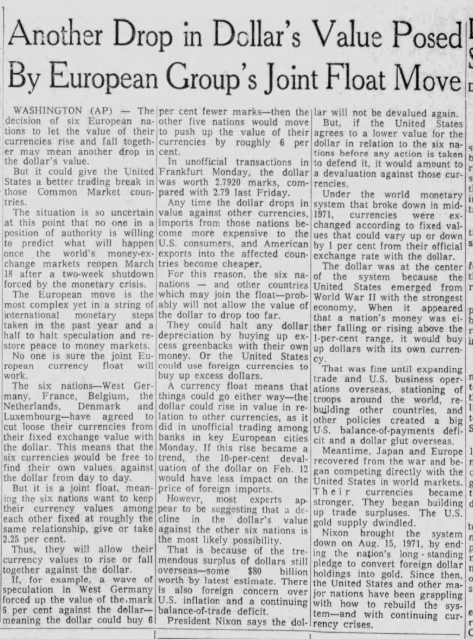
Contemporary press coverage of the European Joint Float, 1972.
The Tunnel Disappears
The international monetary environment continued to change
rapidly. By 1973, the movement toward generalized floating among
major currencies effectively eliminated the dollar-based “tunnel.”
European policymakers were therefore left primarily with the
“snake”: an effort to limit fluctuations among participating
European currencies even while those currencies collectively
floated against the dollar and other currencies.
Maintaining those relationships proved difficult. Countries faced
different inflation rates, economic conditions, and domestic
policy priorities. The oil crisis added another major economic
shock. Several currencies entered, left, or re-entered the
arrangement, and over time participation narrowed considerably.
As an exchange-rate mechanism, the Joint Float had significant
limitations. But the underlying idea survived.
From the Snake to the EMS
European policymakers continued searching for a more durable
system of monetary cooperation. In 1979, the
European Monetary System (EMS) was established
with the objective of creating greater monetary and exchange-rate
stability within Europe.
The EMS represented a significant evolution from the earlier Joint
Float. The Exchange Rate Mechanism (ERM) provided
a framework for managing exchange-rate relationships among
participating currencies, while the
European Currency Unit (ECU) provided a
basket-based unit constructed from participating European
currencies.
The ECU was not yet the euro. It was a composite unit rather than
a single circulating currency backed by one central bank.
Nevertheless, it represented another important step toward
thinking about European monetary relationships collectively rather
than solely through individual national currencies.
From the ECU to the Euro
The movement toward deeper monetary integration continued. The
Delors Report in 1989 outlined a staged approach
toward Economic and Monetary Union. The
Maastricht Treaty, agreed in 1991 and signed in
1992, established the institutional roadmap for monetary union and
a common European currency.
On January 1, 1999, exchange rates among the
initial participating currencies were irrevocably fixed and the
euro was introduced. The ECU was replaced by the euro on a
one-for-one basis.
What had begun decades earlier as an effort to reduce fluctuations
among individual European currencies had ultimately evolved into
something far more significant: the replacement of those
currencies, for participating countries, with a common currency.
The Enduring FX Lesson
It would be too simplistic to draw a straight line from the
European Joint Float of 1972 to the introduction of the euro in
1999. The path included failed arrangements, economic shocks,
currency realignments, political negotiations, and significant
changes in monetary institutions.
But the Joint Float introduced an important idea that proved much
more durable than the mechanism itself:
Increasing economic integration created an increasing need to
address exchange-rate instability.
The European response evolved over time:
An Evolution in European Exchange-Rate Cooperation
European Joint Float
→
European Monetary System
→
ECU & ERM
→
Economic & Monetary Union
→
Euro
Each stage represented a different attempt to answer essentially
the same underlying question:
How should increasingly interconnected economies manage the
uncertainty created by fluctuating exchange rates?
The eventual European answer was extraordinary. Rather than simply
continuing to manage the exchange rates between participating
national currencies, those countries ultimately eliminated those
exchange rates altogether by adopting a common currency.
More than fifty years after the European Joint Float was
introduced, its importance therefore lies less in the longevity of
the arrangement itself and more in the monetary integration that
followed. Sometimes an unsuccessful mechanism can still represent
an important step toward a much more enduring solution.
CFX Group Services
FX Program Review
A focused, independent review of how your company identifies,
evaluates, and manages foreign exchange risk.
Independent advice. No FX product sales. No transaction execution.
Overview
The CFX Group FX Program Review is designed primarily for
middle-market companies with international customers, suppliers, or
operations that may not have dedicated FX expertise. The review
provides management with a clear, practical assessment of the
company's current approach to foreign exchange—highlighting areas
that may warrant attention while also confirming where current
practices are appropriate.
The review follows a defined structure while allowing the scope to
reflect the company's particular activities, exposures, and
circumstances.
Scope of the Review
Depending on the company's activities, the review may consider
several key elements of the FX program.
Foreign currency exposures and international payments
Exposure identification and forecasting
Hedging practices and decision-making
FX policy and governance
Banking and counterparty relationships
Operational processes, controls, and management reporting
Deliverables
At the conclusion of the review, management receives a concise
assessment of the current FX program, including key observations,
areas that may warrant attention, and practical recommendations
for consideration.
Findings are reviewed directly with management, providing an
opportunity to discuss priorities, questions, and potential next
steps.
Typical Timeline
The FX Program Review is designed to be focused and minimally
disruptive to the finance or treasury team. A typical review is
completed over approximately three weeks, depending on the
complexity of the company's FX activities and the availability of
information.
Week 1
Information Gathering & Review
Initial information gathering and review of relevant materials.
Week 2
Discussion & Assessment
Management discussion and independent assessment of the current FX program.
Week 3
Findings & Management Review
Presentation and discussion of observations, priorities, and recommendations.
Fixed-Fee Structure
The FX Program Review is offered on a fixed-fee basis, agreed in
advance, with no ongoing commitment.
Focused by Design
The FX Program Review is a focused assessment rather than an
implementation project. Any additional advisory work identified
through the review can be considered separately.
CFX Group is independent by design. We do not sell FX products or
execute foreign exchange transactions. Our role is to provide an
experienced, objective perspective on your company's FX program.
Interested in Learning More?
If you would like to learn more about the CFX Group FX Program
Review and whether it may be appropriate for your organization,
please provide a few details below. We will follow up to arrange a
brief introductory conversation.
Please do not submit confidential, sensitive, regulated, or
proprietary information through this public website form.
FX Reference Rates
Selected Foreign Exchange Rates
Current reference exchange rates for selected currencies commonly encountered by internationally active companies. Rates are provided for general informational and planning purposes.
Pair
Reference Rate
Prior Day
Daily Change
30-Day High
30-Day Low
EUR/USD
—
—
—
—
—
GBP/USD
—
—
—
—
—
USD/JPY
—
—
—
—
—
USD/CAD
—
—
—
—
—
AUD/USD
—
—
—
—
—
NZD/USD
—
—
—
—
—
USD/MXN
—
—
—
—
—
USD/INR
—
—
—
—
—
USD/BRL
—
—
—
—
—
USD/CHF
—
—
—
—
—
EUR/GBP
—
—
—
—
—
USD/CNY
—
—
—
—
—
EUR/JPY
—
—
—
—
—
GBP/JPY
—
—
—
—
—
USD/SEK
—
—
—
—
—
30-day high and low values represent the range of published daily reference-rate observations over the preceding 30 calendar days; they are not intraday market highs or lows.
Loading latest available reference-rate date…
Reference rates update automatically when this page is opened.
About these rates. Data is supplied by the Frankfurter exchange-rate API using daily rates from central banks and official sources.
Rates are reference rates for informational purposes only. They are not executable transaction prices, bids, offers, or trade quotations and should not be relied upon for transaction execution.
Contact CFX Group
How can we help?
Whether you're evaluating your FX program, expanding
internationally, reviewing treasury operations, or simply have a
question, we'd welcome the opportunity to learn more.
Schedule a Consultation
Choose a convenient time for a 30-minute conversation with CFX
Group.
Use the form and we'll respond as soon as possible.
Email
info@cfxgroupllc.com
Phone
980-217-2253
We typically respond within one business day. For urgent
matters, please call directly.
Tell us how we can help
Share a little about your organization, question, or project
and we'll be in touch promptly.
CFX Insight 006
Not Every FX Risk Needs a Hedge
CFX GroupSeptember 20264-minute read
When a company identifies foreign exchange risk, the natural
response is often: What should we hedge?
That may be the wrong first question.
The better question is:
What is creating the exposure, and how should it be
managed?
A hedge is one way to manage FX risk, but it is not always the
best answer. In some cases, the exposure can be reduced
operationally. In others, the company may decide that the risk is
acceptable. The objective is not to maximize the volume of
hedging. It is to manage uncertainty in a way that supports the
business.
Start with the business decision
Every FX exposure begins with a business decision.
A company decides where to manufacture, what currency to invoice
in, how to price its products, where to source materials, or how
to fund a foreign subsidiary. Those decisions create the exposure.
The financial transaction comes later.
Consider a U.S. company selling into Europe and invoicing
customers in euros. It has created a visible EUR receivable
exposure. A forward contract may protect the dollar value of those
receivables.
But the company should also consider the decisions surrounding
that exposure:
Could some European expenses be paid in euros?
Could the invoicing currency be changed?
Could pricing terms include an FX adjustment mechanism?
Is the exposure recurring and predictable enough to hedge
effectively?
Is the potential earnings impact material?
Those questions may reveal alternatives—or complements—to a
financial hedge.
Four possible responses
Once an exposure has been identified and understood, a company
generally has four choices:
1. Hedge it financially. Forwards, options,
swaps, or other instruments may be appropriate when the exposure
is measurable and the company wants greater certainty.
2. Offset it operationally. The company may
change its sourcing, invoicing, funding, or cash-management
practices to create natural offsets or reduce the exposure at its
source.
3. Allow natural offsets to occur. Foreign-currency inflows and outflows may offset one
another without requiring separate external hedges. Identifying
those offsets can prevent unnecessary transactions.
4. Retain it intentionally. Some exposures
are immaterial, too uncertain, too expensive to hedge, or
consistent with the company’s risk tolerance. Retaining an
exposure can be a valid decision—provided it is understood,
measured, and approved.
Hedging the wrong exposure can create new risk
A hedge does not eliminate uncertainty if the underlying exposure
is poorly defined.
For example, hedging a forecasted foreign-currency sale assumes
that the sale will occur in the expected amount and at the
expected time. If the forecast changes but the hedge remains in
place, the company may be left with an uncovered derivative
position.
This is why hedge decisions should consider:
Exposure certainty
Forecast accuracy
Timing
Materiality
Liquidity requirements
Hedge cost
Accounting consequences
The company’s ability to monitor and adjust the position
A technically correct hedge can still produce an undesirable
business result if those factors are ignored.
The objective is disciplined decision-making
A mature FX program does not begin with products. It begins with
exposure identification, business context, and clearly defined
objectives.
Sometimes the right answer is a forward contract. Sometimes it is
a natural offset, a pricing change, an adjustment to intercompany
funding, or a conscious decision to retain the risk.
The measure of a good FX program is not how much it hedges. It is
whether the company understands its exposures, evaluates its
alternatives, and makes deliberate decisions consistent with its
financial objectives.
All systems, whether it is your automobile, the human body or a
company’s treasury and finance department, need regular
maintenance to ensure optimal performance. Below is a list of
suggestions to help you and your team continue to run smoothly:
1. Communicate
Communicate internally with key stakeholders to ensure you fully
understand how treasury can support their functional areas, but
also externally with banking and other business partners. In
fact, I recommend having meaningful dialogue with your banking
partners at least quarterly, and at least every other
conversation should include time devoted specifically to
treasury management. This will help you stay current on new and
emerging solutions that may help your business as well as keep
your goals and priorities top of mind with them.
2. Explore New Technologies and Processes
Banks and fintech companies are investing significant resources
to develop better tools to support treasurers – but they often
fail to let existing clients know of these innovative new
solutions. And this limited awareness coupled with the human
tendency to become complacent and satisfied with the status quo
may lead to years (even decades) of treasury routines and
processes that remain virtually unchanged. Over time, as
competitors become more efficient, you may fall behind. Instead,
prepare for the future (it will be here before you know it), and
even volunteer to participate in pilot programs if you have the
chance. That will help educate you about the future and may even
allow you to shape how a new service can best support your
business.
3. Embrace Artificial Intelligence (AI)
This could easily fall into the category above regarding new
technologies and processes; however, given the prevalence of
dialogue around AI, especially at the Board of Directors level,
I thought it deserved its own mention. To be clear, AI is still
in its relative infancy and has many bugs that need to be
addressed as well as a significant need for human oversight, but
the potential for significant productivity gains is real. In the
treasury world, I am seeing AI most commonly utilized to help
automate AP and AR reconciliations, invoicing, etc. These are
areas I recommend starting with as most banks have their own
tools that will help support you with this initiative.
4. Continue to Migrate Away from Paper (i.e., Checks) to Digital
Industry studies indicate companies and other organizations
still use paper checks for 50% of their payments. This is one of
the most expensive payment methods coupled with greatly
increased fraud risk. Most banks will gladly help you convert
check payments to credit card or ACH, at no cost, through a
vendor conversion campaign. Credit card payments have the dual
benefits of increasing your days payable outstanding as well as
the rebate earned on card spend. For those vendors reluctant to
accept a card payment (merchant fees are the most common
reason), ACHs are a great win-win alternative.
5. Refresh Your Credit Card Spend Program
Dovetailing with the topic above, it is a good idea to
periodically ensure you are maximizing the benefits of your card
payments. Best practices include aggregating spend across travel
and entertainment (T&E), purchasing (p-card) and vendor
payments (e-payable) as most rebate grids are tiered based on
volume, and the higher the volume the higher the rebate
percentage. Further, card providers continue to aggressively
pursue new business and are offering ever higher rebates to win
clients. When was the last time you tested the market? But one
word of caution: do not use a card with a vendor who will adjust
the price to reflect the associated merchant fees – that price
increase will more than offset the rebate.
6. Manage Your Merchant Credit Card Fees, Including an
Evaluation of Surcharging
Staying on the topic of credit cards, merchant fees for
businesses that accept credit card payments continue to be a
headache for treasury teams. While there is no magic wand to
eliminate these fees, there are steps you can take: a) be sure
to capture all necessary data for each transaction; Level III
pricing requires Level III data collection; b) evaluate merchant
codes that may offer lower interchange rates; c) explore
alternative digital receipt channels for your customers; and d)
most importantly, avoid extra fees caused by PCI non-compliance
– which also brings significant increased liability in the event
of a data breach.
Also, you may want to evaluate surcharging, i.e., adding a
convenience fee for those who pay via credit card. Note: this
practice used to be prohibited, but now laws are changing and
this is gaining more traction in the marketplace. The laws on
this topic do vary by state, so be sure any new initiative is
compliant within your jurisdiction.
7. Manage Bank Analysis Fees
Banks have been criticized for the monthly analysis fees they
charge, most often not for the fees themselves, but rather the
overly complex monthly statements. A dirty little secret in
banking is that most bankers cannot even explain the meaning of
most line items on an analysis statement. Similar to merchant
card processing fees, it is unlikely these fees can be
eliminated, but can be managed by: a) scheduling a treasury
review with your banker to see what services you actually need
and those that may be rationalized – a common example of an
unnecessary expense is a fee to receive paper statements, which
are usually unwanted anyway and available already for free
online; b) benchmarking fees against what other banks would
charge for similar services and monthly volumes; and c) tracking
changes over time as banks tend to increase these fees
periodically, usually 5% +/- annually.
8. Leverage Efficiencies from Full ERP Integration
If your treasury and banking processes are not fully integrated,
it is like a runner having a 25-year-old heart and a 75-year-old
knee. Map your full cash conversion cycle and see what processes
require the most manual data entry.
9. Manage Your Foreign Currency Risks
How do you manage your FX risk? Hint: the answer should not be:
“All of our foreign transactions are denominated in U.S.
Dollars.” First step is to properly identify the risks and then
develop a strategy to mitigate the exposures. This strategy
should be documented and approved at the Board of Directors
level to give CFOs and Treasurers direction and guidelines as
they manage through dynamic changes in foreign currency markets.
These strategies should not be designed to bet on the direction
of currency movements, rather protect the bottom line against
the risk of adverse changes.
10. Manage Interest Rate Risk
Similar to the FX risks noted above, CFOs and Treasurers need
not predict future interest rate movements, but they should
understand the impact of changes in rates. They should also have
a written policy approved by the Board of Directors to serve as
guidelines for managing these risks. Further, and something that
was overlooked for many years as interest rates remained near 0%
coming out of the 2008/09 Great Recession, be sure you are
generating some level of return on your cash balances either
through an attractive earnings credit rate used to offset
analysis fees, or for companies with greater balances, a
formally managed investment program.
11. Stay Vigilant Against Fraud Risk
Fraud continues to be a pervasive challenge, with nefarious
schemes becoming increasingly sophisticated. Again I recommend
regular and ongoing communication with your key internal and
external partners (IT, insurance, audit, banking, etc.) to be
sure you are doing everything you can to prevent and mitigate
fraud/cybersecurity risks as well as plan for recovery and
resiliency if an incident occurs.
This guest contribution reflects the views of the author. CFX
Group publishes guest perspectives for educational and
informational purposes.
Looking for a practical perspective on your FX program?
Schedule a 30-minute consultation to discuss your current approach,
priorities, and opportunities for improvement.
At CFX Group, we believe that transparency, professionalism, and
clear communication are fundamental to every client relationship.
This Disclaimer explains how information on this website is intended
to be used.
Effective Date: August 2026
Informational and Educational Purposes Only
The information provided on this website is for general
informational and educational purposes only. It is not
individualized financial, investment, legal, accounting, tax,
treasury, or other professional advice.
Nothing on this website should be interpreted as a recommendation,
solicitation, or determination that any strategy, policy, product,
service, transaction, or approach is suitable for any particular
organization or circumstance.
No Client or Fiduciary Relationship
Use of this website, including sending a message or submitting
information through the website, does not create a client,
advisory, fiduciary, or other professional relationship with CFX
Group, LLC. A client relationship is established only through a
written engagement agreement executed by CFX Group and the client.
CFX Group does not undertake fiduciary responsibilities unless
expressly agreed to in writing as part of a specific client
engagement.
Your Organization's Circumstances
Every organization has unique objectives, operations, risk
tolerances, resources, financial circumstances, and governance
requirements. Decisions concerning foreign exchange risk
management, hedging, treasury operations, policy, governance, or
related matters should be made after considering the
organization's specific facts and circumstances and, where
appropriate, in consultation with qualified financial, accounting,
tax, legal, and treasury professionals.
CFX Group's Role and Referral Relationships
CFX Group is an independent advisory firm specializing in foreign
exchange advisory, policy, governance, operational assessment, and
education. CFX Group does not directly execute foreign exchange
transactions, operate as a bank, or act as a broker-dealer.
CFX Group may maintain referral relationships with selected
third-party providers whose services may complement our advisory
offerings. Where appropriate, such relationships will be disclosed
to clients. CFX Group may receive compensation in connection with
certain referral relationships.
CFX Group does not control, supervise, warrant, or assume
responsibility for the products, services, performance, acts, or
omissions of any third-party provider. Clients remain responsible
for evaluating whether a third-party provider is appropriate for
their circumstances.
Accuracy, Timeliness, and Forward-Looking Information
CFX Group seeks to provide practical and accurate information;
however, financial markets, exchange rates, laws, regulations,
technologies, and business conditions may change without notice.
CFX Group makes no representation that website content will remain
complete, accurate, current, or applicable to every circumstance.
Any examples, projections, opinions, scenarios, or forward-looking
statements are inherently uncertain and should not be relied upon
as guarantees of future events, performance, or outcomes.
No Warranties
All website content is provided on an “as is” and “as available”
basis without warranties of any kind, express or implied. To the
fullest extent permitted by applicable law, CFX Group disclaims
warranties concerning the completeness, accuracy, reliability,
availability, merchantability, fitness for a particular purpose,
and non-infringement of website content.
Limitation of Liability
To the fullest extent permitted by applicable law, CFX Group, LLC
and its owners, personnel, contractors, and representatives shall
not be liable for any direct, indirect, incidental, consequential,
special, exemplary, or punitive damages arising from or relating
to access to, use of, inability to use, or reliance upon this
website or its content.
Intellectual Property
Unless otherwise noted, the text, graphics, logos, articles,
educational materials, methodologies, and other original content
on this website are owned by or licensed to CFX Group, LLC and are
protected by applicable intellectual property laws. No content may
be copied, reproduced, distributed, modified, published,
displayed, transmitted, commercially used, or incorporated into a
derivative work without prior written permission from CFX Group.
Governing Law
This Disclaimer is governed by the laws of the State of North
Carolina, without regard to conflict-of-law principles.
Questions? Please contact CFX Group at
info@cfxgroupllc.com.
Last Updated: August 2026
Legal
Privacy Policy
At CFX Group, we believe that transparency, professionalism, and
clear communication are fundamental to every client relationship.
This Privacy Policy explains what information may be collected
through this website and how that information may be used.
Effective Date: August 2026
Scope
This Privacy Policy applies to information collected through the
CFX Group website and related online contact and scheduling tools.
It does not govern information handled under a separate client
engagement agreement or the independent practices of third-party
websites and service providers.
Information You Provide
You may voluntarily provide information when you contact CFX
Group, submit the website contact form, schedule a consultation,
or otherwise communicate with us. This information may include:
Your name, business email address, telephone number, and
company.
Your organization type, service interests, appointment details,
and availability.
Information included in a message, inquiry, or other
communication.
Please do not submit confidential, sensitive, regulated, or
proprietary information through the public website contact form
unless CFX Group has specifically asked you to do so through an
appropriate secure channel.
Information Collected Automatically
When you visit the website, certain technical and usage
information may be collected automatically through cookies and
similar technologies. This information may include browser and
device type, approximate geographic area, referring source, pages
or website sections viewed, session activity, and engagement
information.
How We Use Information
Respond to inquiries and communicate with prospective or current
clients.
Schedule and administer consultations or meetings.
Understand website usage and improve website content,
functionality, and visitor experience.
Maintain business records and support legitimate administrative,
security, and legal purposes.
Provide information about services when requested or otherwise
permitted by law.
CFX Group does not sell personal information.
Third-Party Services
Google Analytics helps us understand website
usage and performance.
Microsoft Bookings and Microsoft 365 support
appointment scheduling, calendar administration, and business
communications.
FormSubmit processes information submitted
through the website contact form and forwards the submission to
CFX Group.
CFX Group does not control the independent privacy or security
practices of these providers. Visitors should review the
providers' applicable policies and settings.
Cookies and Analytics Choices
Cookies are small files stored on a device that can support
website functionality and measurement. Visitors may restrict or
delete cookies through browser settings. Limiting cookies may
affect certain website features or the accuracy of analytics
information.
Disclosure of Information
CFX Group may share information with service providers that
support website, scheduling, communications, security, or
administrative functions; when required by law, legal process, or
governmental request; to protect rights, safety, property, or
security; or in connection with a business reorganization,
financing, merger, sale, or transfer. We do not disclose personal
information to third parties for their independent marketing in
exchange for payment.
Data Retention and Security
CFX Group retains information for as long as reasonably necessary
for the purposes described in this Policy, to maintain appropriate
business records, or to satisfy legal and contractual obligations.
We use commercially reasonable administrative and technical
measures intended to protect information. However, no website,
electronic transmission, or storage method can be guaranteed to be
completely secure.
Children's Privacy
This website is intended for business and professional audiences
and is not directed to children under 13. CFX Group does not
knowingly collect personal information from children under 13
through this website.
Your Choices and Requests
You may contact CFX Group to ask questions about information you
submitted, request a correction, or request deletion where
reasonably practicable and legally appropriate. Certain
information may need to be retained for legal, security,
recordkeeping, or legitimate business purposes.
Changes to This Policy
CFX Group may update this Privacy Policy as the website, services,
technology, or legal requirements evolve. The revised version will
be posted on this page with an updated date.
Questions? Please contact CFX Group at
info@cfxgroupllc.com.
Last Updated: August 2026
Legal
Terms of Use
At CFX Group, we believe that transparency, professionalism, and
clear communication are fundamental to every client relationship.
These Terms of Use govern access to and use of this website.
Effective Date: August 2026
Acceptance of Terms
By accessing or using this website, you agree to these Terms of
Use and the Website Disclaimer and Privacy Policy posted on the
site. If you do not agree, please do not use the website.
Permitted Use
You may use this website for lawful, personal, internal business,
and informational purposes. You may not use the website to violate
law, infringe rights, interfere with website operation or
security, introduce malicious code, obtain unauthorized access,
misrepresent identity or affiliation, or collect information about
others without authorization.
No Professional or Client Relationship
Website content is general information and does not constitute
individualized financial, investment, legal, accounting, tax,
treasury, or other professional advice. Use of the website or
submission of an inquiry does not create a client, advisory,
fiduciary, or other professional relationship. A client
relationship is created only through a written engagement
agreement executed by CFX Group and the client.
Intellectual Property
Unless otherwise noted, the website and its text, graphics, logos,
articles, Insights, educational materials, methodologies, names,
designs, and other original content are owned by or licensed to
CFX Group, LLC and are protected by applicable intellectual
property laws.
You may print or save limited portions of the website solely for
your own noncommercial informational use, provided all copyright
and proprietary notices remain intact. You may not copy,
republish, distribute, sell, license, modify, create derivative
works from, publicly display, transmit, scrape, or commercially
exploit website content without prior written permission from CFX
Group.
User Communications
Information submitted through the website must be accurate and
lawful. Do not transmit confidential, sensitive, regulated,
infringing, malicious, or unlawful material through the public
contact form.
Third-Party Services and Links
The website may link to or use third-party services, including
scheduling, analytics, form-processing, content, or
referral-provider websites. These resources are provided for
convenience and do not make CFX Group responsible for their
availability, content, security, privacy, products, services,
performance, or business practices.
Website Availability and Changes
CFX Group may modify, suspend, restrict, or discontinue any part
of the website or its content at any time without notice. We do
not guarantee uninterrupted, error-free, or secure access.
No Warranties and Limitation of Liability
The website and its content are provided on an “as is” and “as
available” basis without warranties of any kind, express or
implied.
To the fullest extent permitted by applicable law, CFX Group, LLC
and its owners, personnel, contractors, and representatives shall
not be liable for any direct, indirect, incidental, consequential,
special, exemplary, or punitive damages arising from or relating
to the website, its content, third-party services, or reliance on
any information provided.
Governing Law and Severability
These Terms are governed by the laws of the State of North
Carolina, without regard to conflict-of-law principles. If any
provision is determined to be invalid or unenforceable, the
remaining provisions will continue in effect to the fullest extent
permitted by law.
Changes to These Terms
CFX Group may revise these Terms as the website, services, or
legal requirements evolve. Continued use of the website after
revised Terms are posted constitutes acceptance of the revised
Terms.
Questions? Please contact CFX Group at
info@cfxgroupllc.com.